Update 14: Beyond the Book – Promoting Minnesota’s French Cultural Heritage

The past few months have been a whirlwind, especially May and early June. They have taken me well beyond the desk—into Greater Minnesota, on an archival deep-dive, and out into the community. What follows is an account of the research, collaboration, and ongoing work of keeping this project moving forward.
Red Lake Falls
You might recall from my last blog post that earlier this year I discovered—unexpectedly—the presence of Genevieve up in Red Lake Falls. She was there in September 1880, locating several quarter-sections of land and registering them at the Crookston Land Office. As a historian, I needed to find an explanation for why this old widow from Little Canada had traveled so far north; it was more than just a pleasant visit from grandma. I knew two of her sons had migrated there in the spring of 1876 to help found the community, but what was she doing there buying land?
What I've discovered ranks right up there with the Montreal brothel and the Red River abortion in terms of groundbreaking scholarship that has emerged from this project. Genevieve was there that autumn because the unique scheme the original settlers had used to secure the colony's land had just been declared fraudulent by the U.S. federal government. Her sons and grandsons—and everyone in the Red Lake Falls colony—were now scrambling to secure land they had lived on for years. It was all hands on deck, and Genevieve made her way north to help.
What is new in my research is that the colony was apparently founded on Indigenous principles of collective ownership. Led by the Bottineaus, the Métis of northwestern Minnesota collectivized the half-breed scrip they had received from the 1863 Treaty of Old Crossing, consolidating it into a contiguous 7,000- to 9,000-acre claim around the water power at Red Lake Falls. They used U.S. legal mechanisms—half-breed scrip, powers of attorney, land registers—to create a de facto reservation for the Métis and their French relatives. While a handful of scholars have noted the use of scrip, no one has ever understood the unique vision the scheme expressed, nor recognized the consequences of its failure.
With the general framework clear, I set out to find the full story in BIA and GLO records from the National Archives and in Red Lake Falls itself. (Keep reading to see how you can help me acquire the records in Washington, DC.)
In May, I drove up to Red Lake Falls to sit at the feet of local legend Virgil Benoit. A retired Professor of French at the University of North Dakota, Benoit also owns a family farm outside Red Lake Falls. Most importantly, he is the founder and president of the Association of the French of the North (AFRAN), the organization behind the annual Chautauqua and Arts Festival at Old Crossing Treaty Park near Huot. Benoit has been arguably the most important figure in survival and promotion of French and Métis heritage of northwestern Minnesota since the 1970s.
Benoit graciously hosted me at his guest house and spent a day-and-a-half taking me to historic sites in the area. His stature in the community opened gates and doors onto private property I would not otherwise have been able to see, such as the Cyr Cemetery (where Isaiah Gervais is buried) and the land 1880 claims of Genevieve Laurence and Pierre Bottineau. At the Old Crossing Treaty Park, Professor Benoit explained the complicated power dynamics at play during the 1863 treaty negotiations, including where U.S. cannons were emplaced and how the Métis used soft power to influence their Indigenous relatives in order to gain an official stake in the ratified agreement.
Prof. Benoit talks at the original location of the Pierre and Martha Bottineau house The Cyr cemetery, on private property Headstone of Isaiah Gervais in the Cyr Cemetery Old Crossing Treaty Memorial near Huot
Click the arrows for more slides.
HOW YOU CAN HELP.
The document that will reveal the true origin story of Red Lake Falls lies undigitized in three archival boxes and a large bound index volume at the National Archives in Washington, DC. It is called the McIntyre Report. A NARA archivist estimated that it contains "hundreds, if not thousands, of pages"—too voluminous for the archivists themselves to copy.
In order to acquire the report, I will need to hire a local researcher to scan it all for me. (I’ve done the math, and it’s both cheaper and more time-efficient to hire it out than to fly to DC myself.) The work will unfold in two steps:
Step 1: Reconnaissance ($150–$200)
What it funds: An initial, targeted on-site archive session by a local researcher. They will pull the bound Index volume and the first box to physically verify the document conditions, check for oversized maps, and count the total page volume.
Step 2: Full Digital Copying ($1,000–$2,000)
What it funds: The local researcher will perform the meticulous process of unfolding, flattening, photographing, and refolding the hundreds (or thousands) of 140-year-old tri-folded packets, letters, affidavits, and notes across all three boxes, and produce a full scan of the tightly bound Index Book.
A direct donation in either amount would go straight toward the research basis for the final chapter in the book.
These are the papers that will expose exactly who did what behind the scenes. It will show the extent of Gervais family involvement in the scheme that was led by their close kin the Bottineaus and it will reveal the worldview that drove the colony’s founders. Only by understanding these things can we truly grasp what it meant—culturally, economically, and emotionally—for Genevieve to come to the rescue when the federal government pulled the rug out from under her loved ones in August 1880. This is both critical research for the last chapter of my book and a cutting-edge inquiry into a totally unique and never-before-documented part of Minnesota history. Thank you for your support.
French Heritage Corridor Conference Bus Tour
The French Heritage Corridor, an off-shoot of the Chicago-Midwest chapter of the French Heritage Society, is an organization whose mission is to connect, synergize, raise awareness, and promote the French heritage of the U.S. Midwest. While the French heritage of Quebec and Louisiana are widely known, the FHC links seven states whose significant French contributions have largely disappeared from public awareness: Illinois, Indiana, Iowa, Michigan, Minnesota, Missouri, and Wisconsin. Each year the FHC hosts a conference that brings together academics, cultural interpreters, local heritage venues, and the general public. Each conference usually includes a formal day of meetings and presentations and a fun day of cultural exploration in whatever locale is hosting.
Minnesota hosted this year’s conference and I was glad to contribute. (It meant great exposure for the book!)
Together with a small committee, I organized a ten-hour bus tour of sites around the Twin Cities, tracing Minnesota’s French heritage from the arrival of Father Louis Hennepin at St. Anthony Falls in the 17th century to French architect Jean Nouvel’s 21st-century landmark, the Guthrie Theater. I co-hosted the tour along with Pierre Girard, vice president of the French-American Heritage Foundation of Minnesota, and we invited several guest speakers to share their expertise. In addition, I put together a slideshow for screens on the bus to showcase maps and images of sites we couldn’t enter.
The feedback was universally positive. For those who missed it, here was our itinerary.
We departed the Fort Snelling Visitor Center at 8:30 a.m. and returned there at 6:30 p.m.

Stop 1. The Basilica of St. Mary
Johan van Parys, Ph.D., the Basilica’s Managing Director of Ministries / Director of Liturgy & Sacred Arts, stepped aboard to talk about the Basilica, in particular the significance of Francophile bishop John Ireland and his favored architect, Emmanuel Masqueray. It would not be the last time we visited a Masqueray masterpiece.
Route: Pierre Girard, dressed as Father Hennepin, introduced the history of the early French explorers as the bus crossed the French-named streets of Minneapolis—Hennepin, Marquette, Lasalle, Nicolet.

When the Irish took over the primary parish church in Minneapolis, the city’s French Catholics moved out. In 1877, they bought an unoccupied Universalist church, converted it into a proper Roman-style structure, covered it with fleur de lis, and named it in honor of a recent miracle in Lourdes, France. Minneapolis City Councilman Michael Rainville, who is also president of the church board, guided the tour, and visitors had an opportunity to buy tourtière (spiced meat pies) from the church office.
Stop 3. The Ard Godfrey House
I’ve been teasing this one for a while, waiting to announce a new exhibit. Alas, grant applications from the Minneapolis Parks Foundation for funding from the Minnesota Historical Society funding keep being rejected.
The Ard Godfrey House is the oldest frame house in Minneapolis. Built in 1849 for
Maine millwright Ard Godfrey and his family, the house has been interpreted through an exclusively New England lens since it first became a museum in 1905.
However, I have uncovered an incredible story of French-Canadian migration, poverty, mental illness, and conflict that took place inside the house in the late 1870s and early 1880s. It’s a story that turns a stale Yankee landmark into a vibrant part of a working-class industrial neighborhood, linking the house to the French community and the church next door, to the sawmills and foundries and textile sweatshops where the immigrants found work, and to other tenements and boarding houses in Northeast Minneapolis.
For the tour, I summarized my research findings in Chute Square before our bus-load of tourists filed single-file through the small, four-bedroom home. (In 1880, twenty-eight French-Canadian immigrants lived inside!)
Please reach out if you want to help fund the development and installation of a permanent exhibit at the house to tell this incredible story!
Stop 4. The Guthrie Theater

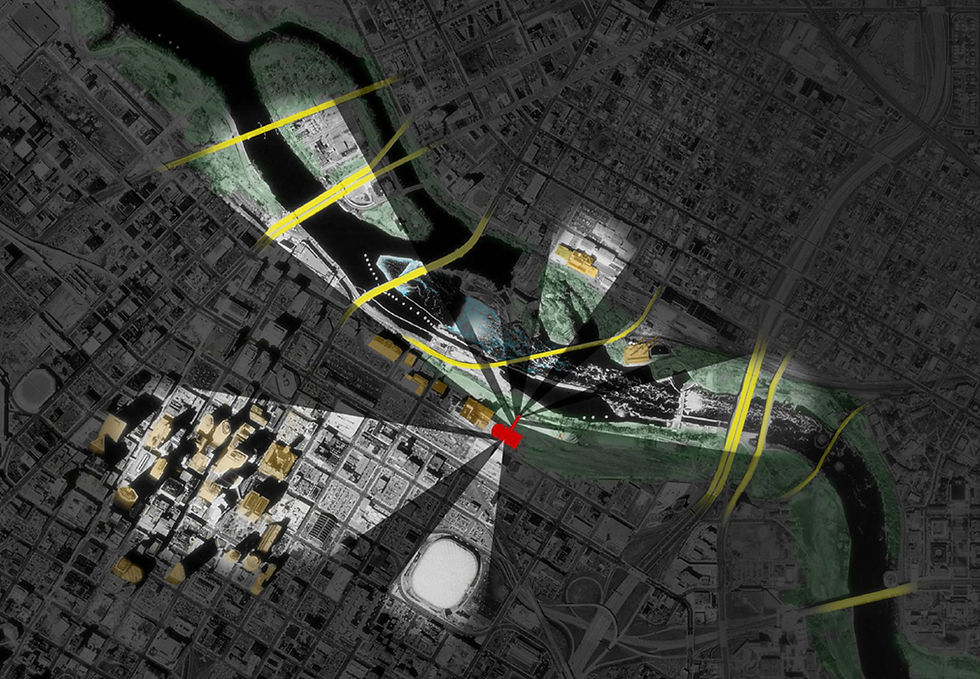
Renowned French architect Jean Nouvel designed the Guthrie in the early 2000s as a landmark that would serve the public while tying the building into Minneapolis's rich riverfront milling history. We toured the theater's beautiful public interior spaces and walked out onto the cantilevered platform—the best vantage point in the city of the Mississippi River, St. Anthony Falls, and the old mill district. We noted Pierre Bottineau's role as an early Minneapolis land developer and pointed out the Our Lady of Lourdes neighborhood to give out-of-state visitors a feel for where we had already been.
Stop 5. Lunch in Little Canada

After a long morning in Minneapolis, we headed east. On the bus, I gave a brief history of Little Canada before we disembarked for a shared meal hosted by the City of Little Canada and the Little Canada Historical Society.
Lunch, provided by Creative Catering of Little Canada, was grounded in everyday French-Canadian cuisine: pea soup, salad, bread and cheese, plus festive tourtière from Our Lady of Lourdes. While visitors ate, Dave Rhees of the band Bundle and Go performed "The Red River Jig" on the historic Gervais fiddle.
You could not have scripted a better representation of Little Canada's roots in the French-Canadian working class.
Back on the bus, Pierre Girard led everyone in a voyageur song to bolster our collective energy—no naps on this tour!
Stop 6: The Cathedral of St. Paul
Minnesota's French heritage doesn't get any bigger than this: a Catholic cathedral designed by a French architect (Masqueray again) that grew from a parish that began inside a tiny log chapel built with donated land, labor, and materials by St. Paul's earliest French and Métis settlers, under the guidance of clergy from France. We spent half an hour in quiet reverence exploring the space.
Drive-Bys: The Minnesota Capitol, St. Louis King of France Catholic Church, and the Wabasha Street Caves
Though our tight schedule prevented full stops, Pierre and I gave inspired, sometimes humorous interpretations of their French connections, as well as a quick mini-plug for French language immersion education around the state. (Hello, Concordia Language Villages!)
The Capitol is full of French imagery. The state motto is L ‘Etoile du Nord. Several artists commissioned to bring color to the Capitol had French heritage or Beaux-Arts training in Paris. The names of French explorers can be seen on the ceiling in the House chambers. Paintings in the Senate and Supreme Court chambers depict the French as explorers and purveyors of law and civic liberties.
St. Louis King of France Catholic Church was Emmanuel Masqueray’s “minor masterpiece”—his own favorite work of ecclesiastical design. He called it his “little gem” because it created beauty at the human scale of a parish church rather than the scale of grandiose public art.
Finally, the caves. The Mississippi River at St. Paul is lined with the sandstone caverns. After a decade hosting Prohibition-era speakeasies, in the 1930s the caves along Wabasha Street were converted to cheese production. A University of Minnesota dairy professor determined that the caves were identical in temperature and humidity to the Roquefort caves in France, where the famed Roquefort cheese was aged. After acquiring some Penicillium roqueforti—the mold that makes the cheese—commercial production began.
The French got word of St. Paul’s threat to the global Roquefort cheese market and send a trade minister for a visit. The minister called St. Paul’s aging rooms “bastard caves,” decried the use of cow’s milk instead of sheep’s milk, and declared: “There is only one Roquefort cheese and it is made in France.”
In the 1940s and ’50s, the caves became home to domestic blue cheese production for Land O’ Lakes and Kraft. But thanks to that French minister, the cheese never sold under the name Roquefort. (Info credit: Greg Brick, "St. Paul Underground: The University Farm Experimental Cave and St. Paul as the Blue Cheese Capital of the World."article published by the Ramsey County Historical Society.)
Stop 7. Historic Mendota
FAHF-Minnesota president and FHC Ambassador Greg Cash introduced the history Mendota. Visitors toured the Faribault and Dupuis houses, learned about St. Peter’s Church, and explored a voyageur canoe camp run by reenactors from La Compagnie de Hivernants des Rivière St-Pierre.
The grand finale of the bus tour was the opportunity to climb aboard a 30-foot replica voyageur canoe for a paddle on the Minnesota River at its confluence with the Mississippi. The shore was authentically muddy, but this did not deter visitors looking for adventure; thirty visitors climbed aboard, including esteemed government and FHS representatives from Québec, New York, and Paris.
FHC Director Lisa Kahn smiles as the devant readies the canoe for departure. Staging and loading canoes along the Minnesota River at Mendota. FHC tour participants paddle up the Minnesota River. In white is Anne St-Jean, Public and Governmental Affairs Officer / Québec Government Office Chicago French Heritage Society vice president Isabelle de Laroullière enjoyed her canoe ride!
Click the arrows for more slides. It has probably been decades if not centuries since the last trade canoe was loaded from shore at Mendota.
Tour End: Soirée at the Fort Snelling Visitor Center
After a whirlwind day bumping around town, it was time for dinner, music, and dancing. Lisa Kahn, the driving force behind the whole FHC endeavor, organized a festive evening soirée. Where lunch had featured authentic but functional foods, dinner reflected the elevated cuisine the French are famous. Iconic French elements such as flageolets accented a foundation of native Minnesota ingredients like walleye, wild rice, and rhubarb.
We feasted on:
· Salade verte with shaved root vegetables and mustard vinaigrette
· Sauté of local Walleye with sauce beurre blanc
· Fresh steamed haricots verts (green beans)
· Wild and white rice with flageolets (white beans)
· Bread and butter
· Raspberry/rhubarb crumble
The bar featured French wines alongside a unique blueberry shrub cocktail.

The whole conference was a success: history, architecture, hands-on experiences, new research, expert guest guides, culinary treats, and live music. We achieved exactly the balance we had set out as our goal.
Fundraising
Since the 2025 MNHS Legacy grant fell through, I’ve devoted considerable time to fundraising.
Together with LCHS, I've expanded outreach to potential major donors. We developed custom-tailored packets and mailed them to individuals with a demonstrated interest and stake in the stories of French North America or Minnesota's cultural diversity. I'll be putting together a few more packets over the next couple weeks.
We've also expanded our grant targets. In late May, LCHS submitted a pre-application for another round of large grants through the Minnesota Historical Society to fund the remaining writing. At the same time, LCHS challenged the statutory authority under which the Cultural Heritage grants program operates at MNHS. The Little Canada Historical Society argues that for a project like this one, it should be permitted to apply under a Single Source Grant Justification—that is, the writing phase should be considered a continuation of the existing contracted partnership between LCHS and me, rather than forcing the project through an open procurement process that offers no benefit to taxpayers and puts LCHS into the unethical position of posting an RFP where other candidates would have little real chance of winning the job. We expect a ruling on eligibility within the next few weeks.
I also applied separately for a Cultural Expressions Grant through the Minnesota Arts Board. If awarded, it would fund my time to write four chapters and develop two public presentations based on them. One presentation would take place in Ramsey County, while the other would present my new research into the origins of Red Lake Falls at the 2027 Chautauqua festival.
Finally, I recently relaunched my website. My audience is broader than ever: artists and writers, scholars, potential major donors, Gervais and Laurence descendants, plus the many people who have encountered this project through public presentations, bus tours, radio interviews, and costumed interpretation. The site needs to speak to all of them, inviting them to reach out, share, and support.
Funding Limitations
If that seems like a short list of grant opportunities, know that I am not resting on my laurels. Part of my work this spring has been surveying the grant landscape only to find that many seemingly ideal opportunities have disqualifying technicalities.
The NEH Public Scholars Program would be a natural fit, but applicants must have already published at least one nonfiction book with a university or trade press. My award-winning interpretive writing for museums doesn't qualify, despite representing exactly the kind of public-facing nonfiction scholarship the program was designed to support.
The Bush Foundation cordially informed us that our project was not a good fit for their current priorities.
The Minnesota Humanities Center is not currently offering grants. Federal funding cuts have severely curtailed its programs. If you care about projects like this one, your vote matters.
The Whiting Foundation Nonfiction Grant would be an excellent fit. It offers $40,000 for works of narrative nonfiction at a crucial mid-stage of completion. The annual deadline just passed at the end of May. I did not apply because applicants must have a fully executed publishing contract in hand at the time of application. Securing a publisher is something I'm actively pursuing, but the timeline is complicated by the ongoing Single Source Justification question before the MNHS Grants Office. (Individually securing a publisher could be disqualifying for the MNHS opportunity if open procurement is required.) Once that question is resolved, pursuing a publishing contract—and then a Whiting grant—becomes a top priority.
The Literary Arts Fund (a new collaborative initiative backed by the Lannan, Mellon, Ford, and MacArthur foundations, among others) offers innovation project grants up to $100,000 with a deadline of August 17, 2026. Unfortunately, grants go only to nonprofit literary arts organizations, not to individual writers or historical societies. I’ve sent out feelers to a couple local literary arts nonprofits. Unless one is willing to serve as fiscal sponsor for the project, this opportunity too is out of reach.
This project sits in an awkward space between academic scholarship and literary nonfiction, and finding grant programs that fit has been a genuine challenge. I am an independent scholar and proven writer who has partnered with a nonprofit to bring groundbreaking original research findings to the public. It seems like exactly what institutions like the Minnesota Historical Society should want to support, given how well it aligns with their mission. Yet navigating my LCHS partnership through current grant guidelines has proven more complicated than anyone anticipated.
Individual donations—many of them modest, all of them meaningful—are what's keeping this project alive. Without them, I could not focus on securing longer-term funding without taking on other paid work. If you've given, thank you. You are the reason this continues.
Eventually I will get back to writing full time. But I cannot comfortably sit down at the keyboard until a basic income is secured for the work. In the meantime, I exist in a state of righteous frustration on the one hand, and eager enthusiasm for what’s to come on the other. I know this will be a great book (and a great streaming series on HBO Max or Netflix). The research keeps delivering. The story keeps getting bigger. I just need the funding to catch up.


kèo nhà cái 5 chuẩn mình thấy mọi người nhắc hoài nên tò mò bấm vào xem thử giao diện thế nào. Mình không có ngồi soi nội dung hay chọn trò gì đâu, chủ yếu lướt qua để xem họ sắp xếp thông tin ra sao cho dễ nhìn. Ấn tượng đầu là bố cục khá thoáng, các mục được chia theo từng khối rõ ràng nên kéo xuống không bị “ngợp”. Mình thích kiểu họ trình bày dữ liệu theo dạng bảng cột gọn gàng, nhìn cái là nắm được ý chính chứ không phải đọc cả đống chữ. Thanh menu cũng đặt chỗ dễ thấy nên chuyển qua lại vài mục khá nhanh, không cần bấm nhiều…
Bài viết trình bày rõ ràng, dễ hiểu, cảm ơn bạn đã chia sẻ. Mình cũng hay theo dõi số liệu thống kê XSMB mỗi ngày nên tự gom lại thành một trang tổng hợp để tra nhanh cho tiện, khỏi phải tìm nhiều nơi. Bạn nào cũng quan tâm dữ liệu cập nhật theo ngày thì ghé xem thử https://writexo.com/share/d8a8b3286dfc
Mình coi xổ số chủ yếu để thư giãn, kiểu xem cho có chuyện chứ không đặt nặng chuyện trúng hay không. Trước đây nghe tụi bạn bàn về “cầu” này “cầu” nọ, mình cũng tò mò thử tìm hiểu nhưng lúc đó mơ hồ lắm. Theo dõi một thời gian thì mình bắt đầu nhận ra có vài dạng hay lặp, nên mỗi lần đọc nhận định mình hay ghi lại mấy ý ngắn rồi chờ kết quả để tự kiểm tra xem có bị tâm lý dẫn dắt không. https://soicauxsmb.io/soi-cau-viet.html Thật ra có hôm trúng chút thì vui, nhưng cũng nhiều lần sai lệch hoàn toàn nên mình luôn nhắc bản thân đừng tin quá. Với mình, mấy…
Trước mình cũng hay nghe người ta truyền miệng mấy kiểu dự đoán, nhưng chơi lâu thì thấy phải giữ cái đầu lạnh và tự đặt luật cho mình. Mình thường chỉ đọc để tham khảo, rồi ghi chú lại vài con thấy hợp mắt, theo dõi thêm một thời gian xem có ổn không. soi cau mb với mình hữu ích nhất ở chỗ giúp mình nhìn ra cách hình thành cầu, chứ không phải cứ bám sát từng chữ là sẽ ăn. Có bữa trúng thì vui, nhưng cũng không ít lần lệch nên mình không dám tin tuyệt đối. Lúc tâm lý đang hăng quá mà đọc phân tích nhiều lại dễ bị cuốn, nên mình hay…